
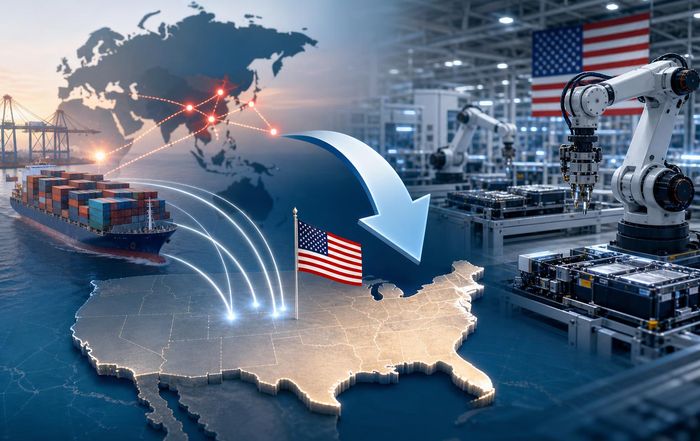
The Business Case for Reshoring Critical Supply Chains
For three decades, globalisation rewarded companies that pushed production to the lowest-cost location. That logic is being rewritten. From semiconductors and pharmaceuticals to batteries and rare earths, governments and boardrooms are reconsidering where critical goods are made, who controls the inputs, and how resilient supply chains really are when crises hit.
Reshoring-bringing production and key suppliers back to a company's home country or to politically aligned economies-is moving from political slogan to hard-nosed business strategy. The question for executives and investors is no longer whether reshoring is happening, but when it makes economic sense and how to execute it without destroying margins.
This fab article examines the business case for reshoring critical supply chains: what is driving the shift, where the numbers add up, where they do not, and how firms can make disciplined decisions rather than reacting to headlines.
From just-in-time to "just-in-case": What changed?
The traditional offshoring model was built on predictable trade flows, cheap container shipping, and relatively stable geopolitics. Companies could minimize unit costs by locating labour-intensive production in lower-wage countries and coordinating logistics through just-in-time systems. That model began to crack under the combined pressure of several shocks.
The most visible catalyst was the COVID-19 pandemic, which exposed vulnerabilities in everything from personal protective equipment to microchips. Lockdowns, port closures, and air-freight disruption created shortages across industries. Automakers in North America and Europe, for example, were forced to idle plants because they could not secure relatively low-cost semiconductor components. Subsequent events-Russia's invasion of Ukraine, attacks on shipping routes in the Red Sea, energy price volatility, and rising tensions between the United States and China-have reinforced the sense that supply chains designed purely for cost are no longer fit for purpose.
Policy responses have accelerated the shift. The United States, through the CHIPS and Science Act and the Inflation Reduction Act, has offered substantial subsidies and tax incentives to semiconductor, battery, and clean-energy manufacturers that invest domestically. The European Union, via initiatives like the EU Chips Act and its Net-Zero Industry agenda, is pursuing similar goals. Official data and commentary from institutions such as the World Trade Organization and OECD point to a broader trend of "friend-shoring" and regionalisation rather than an outright collapse of global trade, but the direction of travel is clear: resilience and security are now strategic priorities, not afterthoughts.
For companies, this shift intersects directly with core business themes such as trade, markets, and investment. The challenge is to translate a macro narrative into firm-level economics.
How reshoring changes the risk-return equation
Reshoring is often portrayed as a trade-off between higher costs and greater security. In practice, the picture is more nuanced. Executives evaluating reshoring decisions are increasingly building integrated models that incorporate not just direct labour and capex, but also risk, volatility, and strategic options.
One of the clearest business arguments for reshoring is the reduction of tail risks-low-probability, high-impact events that can wipe out profits or cripple customer relationships. A pharmaceutical manufacturer reliant on a single overseas active ingredient supplier, for example, faces regulatory, quality, and geopolitical risks that are difficult to price accurately. By moving production closer to end markets or diversifying across friendly jurisdictions, the firm may accept higher recurring costs but materially reduce the probability of catastrophic disruption. Analysts at institutions such as the International Monetary Fund and World Bank have highlighted how such shocks can depress output and investment for years in affected sectors.
Reshoring can also reshape working capital and logistics costs. Longer supply chains typically require higher inventory buffers, more complex coordination, and greater exposure to freight price swings. Shorter, regional supply chains may allow companies to reduce inventory days, respond faster to demand changes, and design more agile product refresh cycles. For consumer-facing businesses and tech hardware makers, the ability to move quickly in response to fashion, regulation, or technology shifts can be worth more than incremental labour savings.
At the same time, executives must be realistic about the capital intensity and timeframes involved. Building a new semiconductor fab, battery plant, or biomanufacturing facility is a multi-year, multi-billion-dollar undertaking. Public incentives can help, but they rarely cover the full cost. Companies need clear views on long-term demand, regulatory stability, and technology trajectories. Independent analysis from organisations such as McKinsey & Company and Boston Consulting Group suggests that the economics of reshoring are most compelling when combined with automation, process innovation, and product redesign, rather than simply transplanting existing low-cost models into high-cost locations.
Where the economics of reshoring are strongest
Reshoring does not make equal sense in every sector. The business case is strongest where supply disruptions are extremely costly, where automation can offset labour arbitrage, and where policy support is durable.
In semiconductors, the combination of national security concerns and extraordinary capital intensity has pushed governments in the United States, Europe, South Korea, and Japan to offer significant incentives. Major chipmakers such as TSMC, Intel, and Samsung Electronics have announced or begun building advanced fabs in the US and EU. For these firms, proximity to key customers and governments, plus subsidy packages, can outweigh higher operating costs. The concentration of cutting-edge chip production in a small number of locations-particularly Taiwan-has been widely cited by bodies such as the European Commission and US Department of Commerce as a systemic vulnerability.
Battery and electric vehicle supply chains present a similar story. To qualify for consumer tax credits under US legislation, EVs increasingly need to use components and critical minerals sourced from domestic or free-trade partners. This has triggered a wave of announced investments in battery plants and cathode/anode materials facilities in North America and Europe. Automakers and suppliers see reshoring as a way to secure access to scarce materials, lock in incentives, and reduce exposure to future trade restrictions. Links between industrial strategy, sustainable transitions, and employment are particularly visible in this sector.
Healthcare and pharmaceuticals provide another strong case. During the pandemic, shortages of basic medicines and medical devices led governments to examine the concentration of production in a handful of Asian suppliers. Some countries have since introduced incentives or mandates to localise manufacturing of certain active ingredients, vaccines, or strategic stockpiles. For large pharma and med-tech companies, reshoring or nearshoring critical steps in their value chains can protect brand reputation and regulatory relationships, even if it marginally increases unit costs. Institutions such as the World Health Organization and national regulators have emphasised the importance of diversified and transparent medical supply chains.
By contrast, for low-margin, highly commoditised goods-such as basic textiles, generic consumer electronics, or simple household items-the direct cost advantages of offshoring often still dominate. In these categories, companies may instead pursue "China+1" or "China+many" strategies, diversifying production across several low-cost countries rather than fully reshoring.
Beyond cost: Strategic benefits that are harder to quantify
Some of the most important advantages of reshoring are strategic and intangible, making them harder to capture in traditional financial models but nonetheless real.
Control and visibility are central. Locating key suppliers closer to engineering and design teams can improve collaboration, accelerate iteration, and reduce quality problems. Manufacturers in sectors like advanced machinery, aerospace, and industrial robotics often report that proximity between R&D, prototyping, and scaled production is a competitive asset. This aligns with broader trends in technology and business, where product cycles are shortening and customer expectations for reliability are rising.
Brand and stakeholder perception also matter. Consumers, investors, and regulators are paying more attention to supply chain ethics, environmental impact, and labour standards. Reshoring to jurisdictions with stronger enforcement can help companies reduce reputational risk around issues such as forced labour, unsafe working conditions, or opaque sourcing. It can also support more credible sustainability reporting, as firms gain better data on emissions, energy use, and waste along their value chains. Frameworks from groups like the Global Reporting Initiative and Sustainability Accounting Standards Board (SASB) encourage such transparency.
In addition, reshoring can create options for future business models. Companies that own or closely control domestic production assets may be better positioned to pivot into new product categories, customise offerings for local markets, or form strategic partnerships with governments and research institutions. For founders and executives focused on long-term value creation, these options can justify upfront investment, even when payback periods are uncertain. This is particularly relevant for readers interested in founders and high-growth ventures in advanced manufacturing.
The hidden costs and risks of reshoring
The case for reshoring is not universally positive. There are material risks and hidden costs that can undermine projects if not properly accounted for.
First, domestic capacity constraints are real. In several advanced economies, manufacturers already struggle to find enough skilled workers in fields such as precision machining, semiconductor engineering, and industrial automation. Rapid reshoring can exacerbate these shortages, driving up wages and training costs. It can also expose companies to domestic political risk: changes in government, shifts in industrial policy, or local opposition to large facilities can alter the economics mid-project. Labour market dynamics tracked by bodies like the US Bureau of Labor Statistics and similar agencies elsewhere highlight structural shortages in many technical occupations.
Second, some reshoring efforts risk simply recreating old models in high-cost environments rather than fundamentally improving productivity. If companies move production without simultaneously investing in digitisation, robotics, and process redesign, they may end up with inflexible, expensive operations that cannot compete globally. That, in turn, could invite future pressure to re-offshore or automate aggressively in ways that unsettle local communities and employees.
Third, there is a danger of over-concentration in the opposite direction. While policymakers often frame reshoring as a way to reduce dependence on a small number of foreign suppliers, concentrating production domestically can create new single points of failure. Natural disasters, cyberattacks, or local infrastructure failures can be just as disruptive as geopolitical shocks. A genuinely resilient strategy often combines selective reshoring with diversification across multiple friendly jurisdictions and robust contingency planning.
Finally, not all public incentives are created equal. Subsidies that appear generous on paper may come with complex conditions, reporting requirements, or political scrutiny. They may also be time-limited, leaving companies exposed when programmes expire. Executives need to stress-test business cases against scenarios in which incentives are reduced or withdrawn, and they must ensure compliance with evolving trade rules overseen by organisations such as the World Trade Organization.
The role of technology in making reshoring viable
Digital technologies and automation are central to making reshoring economically sustainable, particularly in higher-wage economies. Without them, the labour-cost gap between regions can be insurmountable; with them, the gap narrows significantly.
Advanced robotics, computer vision, and AI-driven quality control can automate repetitive tasks and reduce defect rates. Industrial Internet of Things (IIoT) platforms and digital twins enable real-time monitoring of equipment, predictive maintenance, and optimisation of production lines. Cloud-based planning tools and AI-powered forecasting can help synchronise demand and supply more accurately, reducing the need for large safety stocks. These developments intersect directly with broader trends in AI, technology, and economics.
For small and mid-sized firms, the falling cost and increasing modularity of such technologies are particularly important. They allow companies that previously could not justify major capital expenditures to adopt automation incrementally. Public initiatives in regions like North America, Europe, and parts of Asia increasingly include support for digital upskilling, testbeds, and innovation clusters, often in partnership with universities and research institutes such as the Fraunhofer Society in Germany or the National Institute of Standards and Technology in the United States, accessible via fraunhofer.de and nist.gov respectively.
However, technology is not a panacea. Implementation risks are significant, and productivity gains often materialise more slowly than business cases assume. Successful reshoring projects typically involve organisational change, workforce training, and close collaboration with technology providers rather than one-off equipment purchases.
How companies can build a disciplined reshoring strategy
For executives considering reshoring critical supply chains, the most important step is to move beyond binary thinking. The choice is rarely between fully offshored and fully domestic production. Instead, companies can design hybrid models that balance risk, cost, and strategic control.
A structured approach often begins with mapping the full value chain, identifying which components or processes are truly critical-either because they are hard to substitute, subject to regulatory scrutiny, or central to brand promise. Those elements merit the closest attention in reshoring or nearshoring discussions. Less critical components may remain globally sourced, but with diversified suppliers and clearer contingency plans.
Scenario analysis is vital. Firms can model total landed cost under different assumptions: freight prices, energy costs, wage inflation in various regions, tariff regimes, and potential disruptions. They can also assign rough probabilities and financial impacts to extreme events, such as sudden export controls or major cyber incidents. While such estimates are inevitably imprecise, they help anchor discussions in structured trade-offs rather than intuition alone.
Engaging with policymakers early can also be valuable. Industrial strategies and incentive schemes are evolving quickly, and companies that align projects with national or regional priorities-such as decarbonisation, digitalisation, or regional development-may secure more favourable support. At the same time, firms should avoid becoming overly dependent on any single programme or political administration.
Finally, communication with investors, employees, and customers matters. Reshoring often entails visible capital outlays and changes to cost structures. Clear narratives about long-term resilience, innovation, and market positioning can help stakeholders understand why short-term earnings may be affected. For labour forces and communities, credible plans for training, career development, and local engagement can build support and reduce resistance.
What this means for investors, workers, and policymakers
The shift toward reshoring and regionalisation of critical supply chains is reshaping the landscape for investors, workers, and governments alike.
For investors, the key is to differentiate between firms that are proactively redesigning their supply chains and those reacting piecemeal to political pressure. Companies that integrate resilience, technology, and capital discipline into their strategies may incur upfront costs but could enjoy more stable earnings and stronger pricing power over time. Those that ignore the changing environment may face sudden disruptions, compliance costs, or loss of market access. Understanding sector-specific dynamics-particularly in areas such as finance, world trade, and advanced manufacturing-will be critical.
For workers, reshoring presents both opportunities and challenges. It can create new jobs in manufacturing, engineering, logistics, and related services in advanced economies, and it can support more diverse industrial bases in emerging economies that attract "friend-shored" investment. At the same time, many of these roles require higher skill levels, and automation may limit the number of traditional factory jobs created. Policymakers and employers will need to invest in education, vocational training, and lifelong learning to ensure that local workforces can capture the benefits. This directly intersects with themes in employment and regional development.
For policymakers, the rise of reshoring raises questions about coordination and unintended consequences. Subsidy races between jurisdictions can be expensive and distortionary. Overly rigid localisation rules may drive up costs for consumers or slow the deployment of technologies critical to climate and health goals. International bodies such as the OECD and WTO have warned of the risks of fragmenting global markets into competing blocs. Designing policies that enhance resilience without sliding into protectionism will be an ongoing challenge.
A new operating reality, not a passing trend
Reshoring of critical supply chains is not a short-term swing in sentiment; it reflects deeper structural shifts in geopolitics, technology, and risk perception. For many companies, the question is not whether to participate, but how to do so in ways that create sustainable competitive advantage rather than merely following political currents.
The strongest business cases emerge where reshoring is treated as part of a broader transformation: combining regionalisation with automation, digitalisation, and product innovation; engaging with public policy without becoming captive to it; and balancing resilience against cost in a transparent, data-driven way. Firms that approach reshoring through this lens are more likely to build supply chains that can withstand shocks, support strategic goals, and deliver long-term value to shareholders and societies alike.
For executives, founders, and investors watching global news and markets, the message is clear: supply chain location is now a board-level strategic decision, not a purely operational one. Those who recognise that reality early and act with discipline will be better positioned in an era where security, resilience, and sustainability sit alongside cost at the heart of business strategy.
