
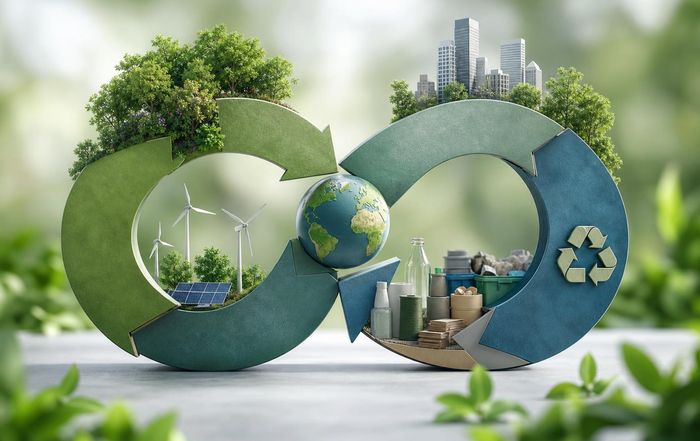
How Circular Business Models Can Improve Resource Efficiency
The Strategic Shift from Linear to Circular Value Creation
The transition from linear to circular business models has moved from theoretical discussion to boardroom imperative, as executives in the United States, Europe, Asia and beyond confront structural resource constraints, rising regulatory pressure and shifting customer expectations. The traditional "take-make-waste" model, which underpinned industrial growth for more than a century, is increasingly incompatible with volatile commodity markets, climate risk and tightening environmental standards. In this context, circular business models-designed to keep products, components and materials in use at their highest value for as long as possible-have emerged as a central lever for improving resource efficiency, enhancing resilience and unlocking new revenue streams.
For the growing professional followers of DailyBusinesss and its top community of business leaders, investors and policy shapers, circularity is no longer a peripheral sustainability topic but a core strategic lens that intersects with business transformation, finance and capital allocation, employment and skills and technology innovation. As organizations across North America, Europe and Asia-Pacific reassess supply chains, product design and customer relationships, they are finding that circular approaches can materially reduce input costs, mitigate supply disruptions and support compliance with emerging regulations such as the European Union's Circular Economy Action Plan and extended producer responsibility rules in countries from Germany to South Korea.
At the same time, leading research from institutions such as the Ellen MacArthur Foundation and OECD has reinforced the macroeconomic case for circularity, showing that resource productivity gains can support GDP growth, job creation and competitiveness while decoupling economic development from environmental degradation. Learn more about the economic potential of the circular economy on the Ellen MacArthur Foundation website. This convergence of environmental necessity and economic opportunity explains why circular business models are now being integrated into mainstream corporate strategy, rather than being confined to corporate social responsibility initiatives.
Defining Circular Business Models and Their Core Principles
Circular business models can be understood as integrated configurations of value creation, delivery and capture that are explicitly designed to minimize waste, maximize resource productivity and regenerate natural systems. Unlike incremental eco-efficiency measures, which often focus on reducing energy or water use within existing linear models, circular models fundamentally reframe how value is generated and how ownership, access and responsibility are distributed across the value chain.
Common archetypes include product-as-a-service models, where customers pay for outcomes such as mobility or lighting rather than owning cars or lamps; product life extension and refurbishment, in which companies design for durability, repairability and resale; resource recovery and industrial symbiosis, where waste streams from one process become feedstock for another; and sharing platforms that increase utilization rates of underused assets. The World Economic Forum provides a detailed overview of these archetypes and their implications for global value chains, which can be explored further through its resources on circular economy innovation.
Across these models, several principles consistently underpin circularity: designing out waste and pollution from the outset, keeping products and materials in use at their highest value, and regenerating natural systems rather than merely exploiting them. These principles are increasingly reflected in regulatory frameworks and voluntary standards, from the ISO suite of environmental management standards to the UN Environment Programme's guidance on sustainable consumption and production. Businesses seeking to understand how these principles translate into operational practice can consult resources from UNEP on sustainable consumption and production patterns.
Resource Efficiency as a Board-Level Performance Metric
Resource efficiency-defined as the ratio of economic output to material, energy and water input-has become a strategic performance metric for companies facing rising input costs, carbon pricing and stakeholder scrutiny. In sectors ranging from manufacturing and construction to consumer goods and technology, executives are recognizing that reducing material intensity can deliver cost savings, lower emissions and enhance supply security, all of which are essential in an era of geopolitical fragmentation and climate volatility.
Data from organizations such as the International Resource Panel and International Energy Agency demonstrate that global material use has more than tripled since 1970 and continues to grow, driven by urbanization, infrastructure expansion and rising consumption in emerging economies. The International Resource Panel provides in-depth analysis of global material flows and resource productivity trends on its official site. As resource extraction and processing account for a substantial share of greenhouse gas emissions and biodiversity loss, improving resource efficiency is not only an economic necessity but also a climate and nature imperative, particularly for companies operating in Europe, North America and Asia-Pacific where regulatory expectations are accelerating.
For readers of DailyBusinesss, this shift is reflected in how investors and lenders evaluate corporate performance. Asset managers integrating environmental, social and governance criteria increasingly scrutinize companies' exposure to resource price volatility, their ability to decouple revenue from material throughput and their preparedness for stricter waste and recycling rules. Insight into how these trends intersect with investment strategies and global markets is shaping capital flows toward businesses that can demonstrate credible circular strategies and measurable resource efficiency gains.
Economic Rationale: Cost, Risk and Competitive Advantage
The economic rationale for circular business models rests on three intertwined pillars: cost optimization, risk mitigation and competitive differentiation. On the cost side, companies that design products for longevity, modularity and recyclability can reduce material input needs, extend product lifecycles and capture residual value at end-of-use through remanufacturing or secondary markets. Studies from McKinsey & Company and other consultancies have shown that circular strategies can significantly reduce bill-of-materials costs in sectors such as automotive, electronics and consumer goods, while also lowering waste management expenses. Executives can explore detailed sectoral analyses through resources such as McKinsey's insights on circular economy and resource productivity.
Risk mitigation is equally important, particularly for companies exposed to volatile commodity prices, supply chain disruptions and tightening regulations. By diversifying feedstock sources through recycled materials, secondary raw materials and industrial symbiosis partnerships, businesses can reduce dependence on virgin resource extraction in politically unstable regions. For example, in critical minerals and metals essential to AI, batteries and clean technologies, circular approaches such as urban mining and closed-loop recycling are becoming strategic priorities in countries like the United States, Germany, Japan and South Korea. The International Energy Agency provides comprehensive analysis of critical minerals and the role of recycling in securing supply, accessible via its work on critical minerals and clean energy transitions.
Competitive advantage is increasingly derived from the ability to offer customers products and services that combine performance, convenience and sustainability. Brands that integrate circular design, repair services and take-back schemes can strengthen customer loyalty, differentiate from low-cost competitors and access premium segments, particularly in markets such as the European Union and North America where consumer awareness of sustainability is high. For B2B customers, circular offerings that enhance resource efficiency, reduce downtime and support compliance with ESG requirements can become decisive factors in procurement decisions. Readers can explore how these dynamics affect corporate strategy and global business trends across developed and emerging markets.
Regulatory Drivers and Policy Signals Worldwide
The policy environment in 2026 strongly favors organizations that proactively adopt circular business models and resource-efficient practices. The European Union remains at the forefront, with its Circular Economy Action Plan, Ecodesign for Sustainable Products Regulation and extended producer responsibility schemes for electronics, packaging and vehicles setting ambitious requirements for durability, reparability, recyclability and recycled content. Businesses operating in or exporting to the EU must now integrate circular design considerations into product development, supply chain management and after-sales service. Details of these regulations can be explored through the European Commission's resources on circular economy policies.
In North America, regulatory signals are more fragmented but increasingly convergent. Several U.S. states have introduced right-to-repair laws, mandatory recycling targets and producer responsibility frameworks, while federal agencies incorporate circularity into infrastructure and procurement policies. Canada has advanced national strategies on zero plastic waste and resource recovery, with implications for packaging, consumer goods and industrial sectors. The U.S. Environmental Protection Agency offers guidance and case studies on sustainable materials management and circular economy initiatives, which are influencing corporate compliance and innovation strategies.
Across Asia-Pacific, major economies are embedding circularity into long-term development plans. China's Circular Economy Promotion Law, updated policy frameworks and pilot industrial parks are driving resource efficiency in manufacturing hubs, while Japan and South Korea are strengthening recycling targets and green procurement standards. The OECD provides comparative analysis of circular economy policies across member and partner countries, accessible through its work on circular economy and resource productivity. For global businesses and investors who follow regulatory developments via DailyBusinesss news coverage, this evolving landscape reinforces the need to treat circularity as a compliance, risk and growth issue simultaneously.
Sectoral Opportunities: From Manufacturing to Services
Different sectors are embracing circular business models in distinct but complementary ways, shaped by their material intensity, product lifecycles and customer expectations. In manufacturing, particularly in automotive, aerospace, machinery and electronics, circularity focuses on design for disassembly, remanufacturing and high-quality recycling. Companies such as Renault, Caterpillar and Siemens have developed industrial-scale remanufacturing operations that recover components and materials from used products, delivering significant resource savings and new revenue streams. The International Resource Panel and Ellen MacArthur Foundation both provide sector-specific case studies illustrating how industrial firms implement these models in practice.
In consumer-facing sectors such as fashion, furniture and consumer electronics, circular strategies often center on resale, repair, refurbishment and rental. Brands and platforms are experimenting with subscription models, buy-back programs and certified refurbished offerings to keep products in circulation longer, particularly in markets like the United Kingdom, Germany, France and the Nordic countries where second-hand consumption is increasingly mainstream. Learn more about sustainable business practices in fashion, retail and consumer goods through UNEP's work on sustainable consumption and lifestyles.
Service-based sectors are also discovering circular opportunities by shifting from product sales to outcome-based contracts, where providers retain ownership of assets and optimize their performance over time. In building management, lighting, industrial equipment and mobility, product-as-a-service models incentivize providers to design durable, efficient and upgradeable solutions, thereby maximizing resource efficiency. For readers tracking employment and skills trends, this shift is creating demand for new roles in maintenance, repair, reverse logistics and circular supply chain management, particularly in advanced economies where service sectors dominate GDP.
Digital Technologies as Enablers of Circular Resource Efficiency
The convergence of digital technologies with circular business models is a defining feature of the current phase of transition. Artificial intelligence, the Internet of Things, cloud computing and blockchain-based systems are enabling unprecedented visibility into material flows, product usage patterns and asset performance, which in turn supports more precise, data-driven circular strategies. On DailyBusinesss, coverage of AI and emerging technologies increasingly intersects with reporting on resource efficiency, climate risk and industrial innovation.
Sensor-equipped products and connected assets generate real-time data on usage, wear and performance, allowing companies to shift from reactive maintenance to predictive and condition-based service models. This not only extends asset lifetimes and reduces downtime but also optimizes spare parts inventories and material use. AI-driven analytics can identify patterns in product returns, failures and material degradation, informing design improvements that enhance durability and recyclability. The World Economic Forum and Accenture have highlighted how digital technologies support circular manufacturing and supply chain optimization, and executives can explore these insights through resources on Fourth Industrial Revolution technologies and circularity.
Blockchain and distributed ledger technologies are being tested to improve traceability of materials, particularly in sectors such as critical minerals, textiles and food, where provenance and compliance with environmental and social standards are essential. Transparent, tamper-resistant records of material origins, processing and ownership changes can support closed-loop systems, facilitate recycling and reassure regulators and customers. For investors and technologists following the convergence of crypto and digital infrastructure with sustainability, these developments illustrate how digital assets and smart contracts might underpin future circular ecosystems.
Finance, Investment and the Circular Capital Stack
Capital allocation is a decisive factor in scaling circular business models, and by 2026, financial markets are beginning to differentiate between linear and circular strategies more clearly. Green bonds, sustainability-linked loans and impact investment vehicles are increasingly tied to resource efficiency metrics, waste reduction targets and circularity indicators. Financial institutions such as ING, BNP Paribas and development banks have developed dedicated frameworks and products to finance circular projects, from industrial retrofits and recycling infrastructure to product-as-a-service platforms. The World Bank and International Finance Corporation offer guidance on financing circular economy initiatives, accessible through their resources on green and inclusive growth.
For corporate treasurers and CFOs, integrating circularity into financial planning involves assessing the long-term value of assets, residual values, reverse logistics costs and potential new revenue streams from secondary markets. It also requires engaging with investors who increasingly expect transparent reporting on resource use, waste generation and circular strategies. Frameworks from the Global Reporting Initiative and Sustainability Accounting Standards Board support disclosure of material circularity-related information, which can influence cost of capital and market valuations. Executives can explore these reporting standards further via the Global Reporting Initiative's resources on sustainability reporting.
Within the DailyBusinesss audience, which closely follows finance, investment and markets, the question is shifting from whether circular models are financeable to how quickly capital can be reallocated from linear, resource-intensive assets to circular, resource-efficient alternatives. This capital reallocation is particularly relevant for infrastructure, manufacturing and real estate in major economies such as the United States, United Kingdom, Germany, China and Japan.
Employment, Skills and the Human Dimension of Circularity
The transition to circular business models has profound implications for employment, workforce skills and organizational culture. While automation and digitalization may reduce labor needs in some linear production processes, circularity tends to increase demand for roles in design, maintenance, repair, refurbishment, remanufacturing and recycling, many of which are geographically anchored and less susceptible to offshoring. The International Labour Organization has highlighted the potential for green and circular jobs to support just transitions, particularly in sectors undergoing structural change. Further insights on these dynamics can be found through the ILO's work on green jobs and the future of work.
For employers, this means investing in reskilling and upskilling programs that equip workers with capabilities in circular design, material science, data analytics, reverse logistics and service-oriented customer engagement. Universities, vocational institutions and corporate academies across Europe, North America and Asia are beginning to integrate circular economy principles into engineering, business and design curricula, responding to demand from companies seeking talent aligned with their circular strategies. Readers interested in how these shifts affect employment landscapes and talent competition can track emerging case studies and policy responses on DailyBusinesss.
Organizationally, circularity requires cross-functional collaboration between design, procurement, operations, finance, marketing and sustainability teams. It challenges traditional KPIs that prioritize volume sales and short-term margins, encouraging metrics that reflect lifecycle value, utilization rates and resource productivity. Leadership commitment, incentive alignment and internal storytelling are therefore essential to embed circular thinking into corporate culture, particularly in large organizations with entrenched linear business models.
Global Trade, Geopolitics and the Geography of Circular Value Chains
As circular business models scale, they are reshaping patterns of global trade and influencing geopolitical dynamics. Trade in secondary materials, refurbished products and remanufactured components is growing, while some countries tighten controls on waste exports to avoid environmental dumping and encourage domestic resource recovery. The World Trade Organization has begun to explore how trade rules intersect with circular economy policies, including issues related to standards, non-tariff barriers and environmental regulations. Business leaders can explore these discussions through the WTO's analysis of trade and the circular economy.
For multinational companies, the geography of circular value chains involves balancing local processing and repair capabilities with global sourcing and distribution networks. High labor costs in Europe or North America may be offset by automation and productivity gains in remanufacturing, while policy incentives encourage local recycling and material recovery. Emerging economies in Asia, Africa and South America are positioning themselves as hubs for recycling, refurbishment and remanufacturing, provided that environmental and labor standards are robust. Readers following world trade and economic developments on DailyBusinesss will recognize that circularity is becoming an important dimension of industrial policy, trade negotiations and regional competitiveness strategies.
Geopolitically, the ability to recover and recycle critical materials domestically is increasingly seen as a strategic asset, reducing dependence on imports from politically sensitive regions. Countries such as the United States, Japan and members of the European Union are investing in circular supply chains for batteries, electronics and renewable energy technologies, often in partnership with allies. These initiatives intersect with broader conversations about industrial resilience, friend-shoring and the future of globalization, which are central themes for the global business community.
Mega Needs for Biz Leaders
For educated executives, founders and investors who engage with DailyBusinesss to understand the future of business, economics and technology, the strategic imperative is clear: circular business models and resource efficiency are no longer optional enhancements but foundational elements of long-term competitiveness and resilience. The organizations that will lead in 2030 and beyond are those that, have begun to systematically redesign products, services and value chains around circular principles, supported by robust data, digital tools and aligned financial incentives.
This involves conducting rigorous materiality assessments to identify where resource intensity and waste generation are most significant, setting science-based targets for resource efficiency and waste reduction, and integrating circularity into core business planning rather than treating it as an isolated sustainability program. It requires engaging customers, suppliers, employees and regulators in co-creating new value propositions that align economic performance with environmental stewardship. It also demands transparency and credible reporting, enabling investors and stakeholders to evaluate progress and hold organizations accountable.
In a world characterized by resource constraints, climate disruption and shifting societal expectations, linear models that externalize environmental costs and rely on endless extraction are increasingly untenable. Circular business models offer a pragmatic, economically grounded pathway to improve resource efficiency, reduce risk and unlock innovation across sectors and geographies. For the wide spread audience of DailyBusinesss, the question is not whether this transition will occur, but how quickly organizations can adapt and how effectively they can capture the value that circularity makes possible in an interconnected, resource-constrained global economy.
